
| Community Warden at Buglife
A SSSI - A Site of Special Scientific Interest
A SSSI is a formal conservation designation. Typically it describes an area that is home to a rare species of flora or fauna, unique geological, or even special physiological features that make it of particular interest to science and conservation.
SSSI’s are designated to provide higher levels of protection than other designations, such as the Areas of Outstanding Natural Beauty (AONB) as an example. While these sites are the most protected, that doesn’t mean they are rare. England alone has over 4,000 SSSIs which cover over 4,200 square miles - just over half the size of Wales.
GreenTheUK’s charity partner, Buglife, jointly manages 19 hectares of the Canvey Wick nature reserve with the RSPB. This SSSI in Essex is a site where we have been fortunate to host volunteering days with our business partners.
So, why is Canvey Wick so special?
It is due to the phenomenal range and rarity of invertebrates, and the array of habitats found at Canvey Wick, that it was designated as the first brownfield Site of Special Scientific Interest (SSSI) specifically for invertebrates back in 2005.
This entire SSSI site of 93 hectares is owned by The Land Trust and the 19 hectares that currently forms the nature reserve is managed by RSPB and Buglife. Since 2014, when the reserve was officially opened, visitors have been invited to enjoy the beauty of this brownfield setting via a network of footpaths and the bee and orchid trails. It is remarkable to see the open mosaic habitats and wild flower rich areas, that are so important for the endangered invertebrates lifecycles, that have developed from the decommissioned and overgrown oil refinery.
It is a haven for invertebrates with over 1,500 species having been recorded so far! With nationally important assemblages including endangered species such as Shrill Carder Bee (Bombus sylvarum) Brown-banded Carder Bee (Bombus humilis), Canvey Island Ground Beetle (Scybalicus oblongiusculus) and Five-banded Weevil Wasp (Cercersi quinquefasciata).
The Shrill Carder Bee is one of the UK’s rarest bumblebees with a very limited distribution and isolated populations. The Thames Gateway (including Canvey Wick, Tilbury and West Thurrock) is one of the few remaining isolated populations, as these brownfield sites provide the variety of forage flowers and habitats necessary for this bumblebee to thrive.
Beyond the reserve
Canvey Wick nature reserve is the south western section of the site, the rest of the SSSI land is not part of the reserve, and therefore not readily accessible to the public. It has mostly been left to natural processes so that the bare ground and grassland habitats preferred by the invertebrates have given way to extensive areas of scrub. Buglife is actively conducting invertebrate surveys across the site to monitor these populations.
Industrial Artwork
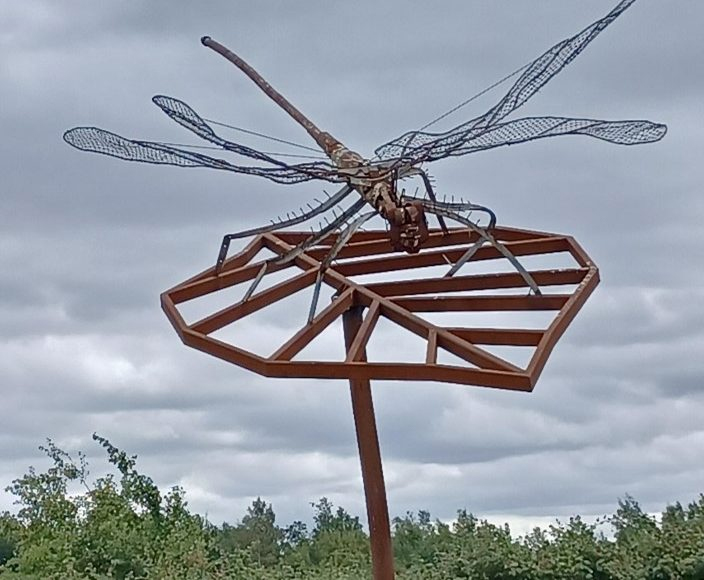
As an, “and finally” this sculpture, at the entrance to the nature reserve, was crafted from discarded materials found at Canvey Wick. It is perhaps a prompt reminder of how beauty can reappear from the remains of our industrial past.